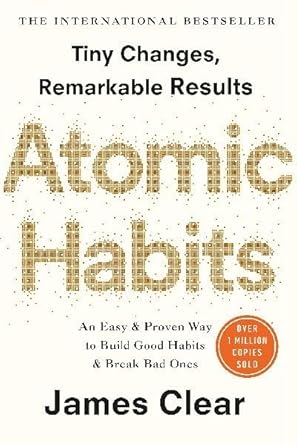
Atomic Habits is a powerful book by James Clear that explains how small, consistent improvements can lead to remarkable results. The book focuses on how habits shape our identity and how we can build good habits while breaking bad ones.
Key Ideas from Atomic Habits
1. The Power of Tiny Changes
- 1% Better Every Day: Small improvements may seem insignificant, but when compounded over time, they create massive transformations.
- The Plateau of Latent Potential: Change takes time, and results are often delayed. Stay consistent, even when progress isn’t visible.
2. The Four Laws of Behavior Change (How to Build Good Habits & Break Bad Ones)
James Clear introduces a framework for forming habits using four key steps:
✅ How to Build Good Habits:
- Make it Obvious
- Design your environment to encourage good habits (e.g., keep healthy snacks visible).
- Use “habit stacking” (attach a new habit to an existing one, e.g., “After brushing my teeth, I will meditate for 1 minute”).
- Create clear implementation intentions: “I will [habit] at [time] in [location].”
- Make it Attractive
- Pair a habit you need to do with one you enjoy (e.g., listen to music while exercising).
- Surround yourself with people who already have the habits you want.
- Make it Easy
- Reduce friction: Make the habit simple to start (e.g., lay out workout clothes the night before).
- Use the 2-minute rule: Start with an easy version of the habit (e.g., “I will read one page” instead of “I will read for an hour”).
- Optimize your environment to remove barriers.
- Make it Satisfying
- Reward yourself to reinforce the habit (e.g., track progress in a habit tracker).
- Use immediate rewards to stay motivated.
- Never miss twice: If you fail one day, get back on track the next day.
❌ How to Break Bad Habits:
- Make it Invisible – Remove triggers (e.g., keep junk food out of the house).
- Make it Unattractive – Reframe the habit by focusing on its negative consequences.
- Make it Difficult – Increase friction (e.g., delete social media apps from your phone).
- Make it Unsatisfying – Get an accountability partner or impose penalties for failure.
3. Identity-Based Habits: Focus on WHO You Want to Become
- Most people focus on outcomes (“I want to lose weight”). Instead, focus on identity (“I am a healthy person”).
- Every action is a vote for the type of person you want to become.
- Example: Instead of saying “I have to run,” say “I am a runner.”
4. The Habit Loop: Cue → Craving → Response → Reward
Every habit follows a cycle:
- Cue: The trigger that starts the habit.
- Craving: The desire for a reward.
- Response: The actual habit or action.
- Reward: The benefit that reinforces the habit.
Example:
- Cue: See a cookie.
- Craving: Want something sweet.
- Response: Eat the cookie.
- Reward: Enjoy the taste (reinforces the habit).
To change habits, alter the cues and rewards.
5. Environment is Stronger Than Motivation
- Instead of relying on willpower, design your surroundings to make good habits easier and bad habits harder.
- Example: If you want to read more, put a book next to your bed.
How to Apply Atomic Habits in Daily Life
Let’s break it down on how to use Atomic Habits principles in daily life for personal growth.
📌 Personal Growth Action Plan (Using Atomic Habits)
1. Identity Shift: Become the Person You Want to Be
🔹 Instead of saying: “I want to read more,” say: “I am a reader.”
🔹 Instead of “I want to be more disciplined,” say: “I am someone who prioritizes self-improvement.”
✅ Action: Write down the type of person you want to become in your journal or notes.
2. Build Key Personal Growth Habits
Here are a few habits you might want to develop (pick the ones that resonate with you):
1️⃣ Reading & Learning Daily
- 🎯 Make it Obvious → Keep a book where you’ll see it (e.g., bedside table).
- 🔗 Use Habit Stacking → “After my morning coffee, I will read for 10 minutes.”
- ⏳ Make it Easy → Start with 5–10 minutes a day or just one page (2-minute rule).
- ✅ Track Progress → Use a habit tracker or a reading journal.
2️⃣ Journaling for Self-Reflection
- 📒 Make it Easy → Start with 1–2 sentences a day.
- 🎯 Use Triggers → “After brushing my teeth at night, I will write one thought in my journal.”
3️⃣ Developing a Growth Mindset
- 💡 Affirmations & Reframing → Instead of saying, “I can’t do this,” say, “I’m learning and improving every day.”
- 🎧 Listen to Podcasts or Audiobooks → Instead of social media scrolling, replace it with self-growth content.
3. Eliminate Distractions & Bad Habits
❌ Make Bad Habits Harder
- If you procrastinate on personal growth → Set up a dedicated space for learning.
- If social media is a distraction → Keep your phone in another room while reading.
- If Netflix keeps you from sleeping early → Set a timer to turn off the TV after one episode.
✅ Accountability Hack
- Use a friend or mentor as an accountability partner.
- Track your progress with a journal or app.
4. Stay Consistent & Motivated
✔ Follow the “Never Miss Twice” Rule – If you miss a day, get back on track the next day.
✔ Celebrate Small Wins – Reward yourself after a streak (e.g., buy a new book after finishing three).
✔ Focus on Long-Term Identity, Not Just Goals – You’re building a lifestyle, not just completing a task.
💡 Next Steps:
1️⃣ Pick 1–2 habits from the list above.
2️⃣ Write down when and where you’ll do them (Implementation Intention).
3️⃣ Start small (use the 2-minute rule).
4️⃣ Track progress and adjust as needed.
Here’s a simple Personal Growth Habit Tracker based on Atomic Habits. You can print it, use it in a journal, or track it digitally! 🚀
📒 Personal Growth Habit Tracker
| Habit | Goal (Time/Frequency) | Mon | Tue | Wed | Thu | Fri | Sat | Sun | ✅ Notes |
|---|---|---|---|---|---|---|---|---|---|
| 📚 Read a Book | 10 mins/day | ⬜ | ⬜ | ⬜ | ⬜ | ⬜ | ⬜ | ⬜ | |
| ✍️ Journal | 1 sentence/day | ⬜ | ⬜ | ⬜ | ⬜ | ⬜ | ⬜ | ⬜ | |
| 🎧 Listen to a Podcast | 15 mins/day | ⬜ | ⬜ | ⬜ | ⬜ | ⬜ | ⬜ | ⬜ | |
| 🏋️ Exercise | 20 mins/day | ⬜ | ⬜ | ⬜ | ⬜ | ⬜ | ⬜ | ⬜ | |
| 📵 Reduce Social Media | < 1hr/day | ⬜ | ⬜ | ⬜ | ⬜ | ⬜ | ⬜ | ⬜ |
✅ How to Use:
- Fill in the habits you want to track.
- Check off each day when you complete a habit.
- Add notes on how you feel or what to improve.
======================================================================================A NEW YORK TIMES AND SUNDAY TIMES BESTSELLER
‘A supremely practical and useful book.’ Mark Manson, author of The Subtle Art of Not Giving A F*ck
‘James Clear has spent years honing the art and studying the science of habits. This engaging, hands-on book is the guide you need to break bad routines and make good ones.’ Adam Grant, author of Originals
‘Atomic Habits is a step-by-step manual for changing routines.’ Books of the Month, Financial Times
‘A special book that will change how you approach your day and live your life.’ Ryan Holiday, author of The Obstacle is the Way